Checklist: How to Evaluate a Cobalt Mining Junior Before You Invest
October 09, 2026 - Market


October 08, 2026 - Market

September 30, 2026 - Uses

September 28, 2026 - Uses
Natural cobalt is almost entirely one isotope, and it is not radioactive. Every other cobalt isotope you will meet in a hospital basement, a sterilisation plant or a research reactor is manufactured, and each one has a distinct personality. Cobalt-60 throws out penetrating gamma rays and is built for brute-force work. Cobalt-57 delivers a tidy, low-energy signal for fine measurement. Cobalt-58 sits somewhere in between and turns up in the strangest places, from hip implant studies to the cooling circuits of nuclear plants. Knowing which is which takes about five minutes, and it saves a lot of confusion later.
Essentially all cobalt in the ground is cobalt-59. It is stable, and it is the isotope that ends up in superalloys for turbine blades, in the cathodes of lithium-ion batteries, in pigments and in vitamin B12. The isotopes that do the interesting technical work are made rather than mined, usually by placing a stable target material in a neutron flux inside a research reactor, or by firing charged particles at it in a cyclotron.
Half-life is the first thing to check. Cobalt-60 has a half-life of about 5.27 years, cobalt-57 around 272 days, and cobalt-58 roughly 71 days. That single number shapes everything practical: how often a source must be replaced, how much shielding enclosure is needed, and how much paperwork sits behind a shipment.
Cobalt-60 decays to nickel-60, emitting a beta particle and two gamma rays at roughly 1.17 and 1.33 MeV. Those energies are high, which means the gamma rays travel far through matter before being absorbed. That is exactly what makes the isotope valuable, and exactly what makes it a serious radiological hazard.
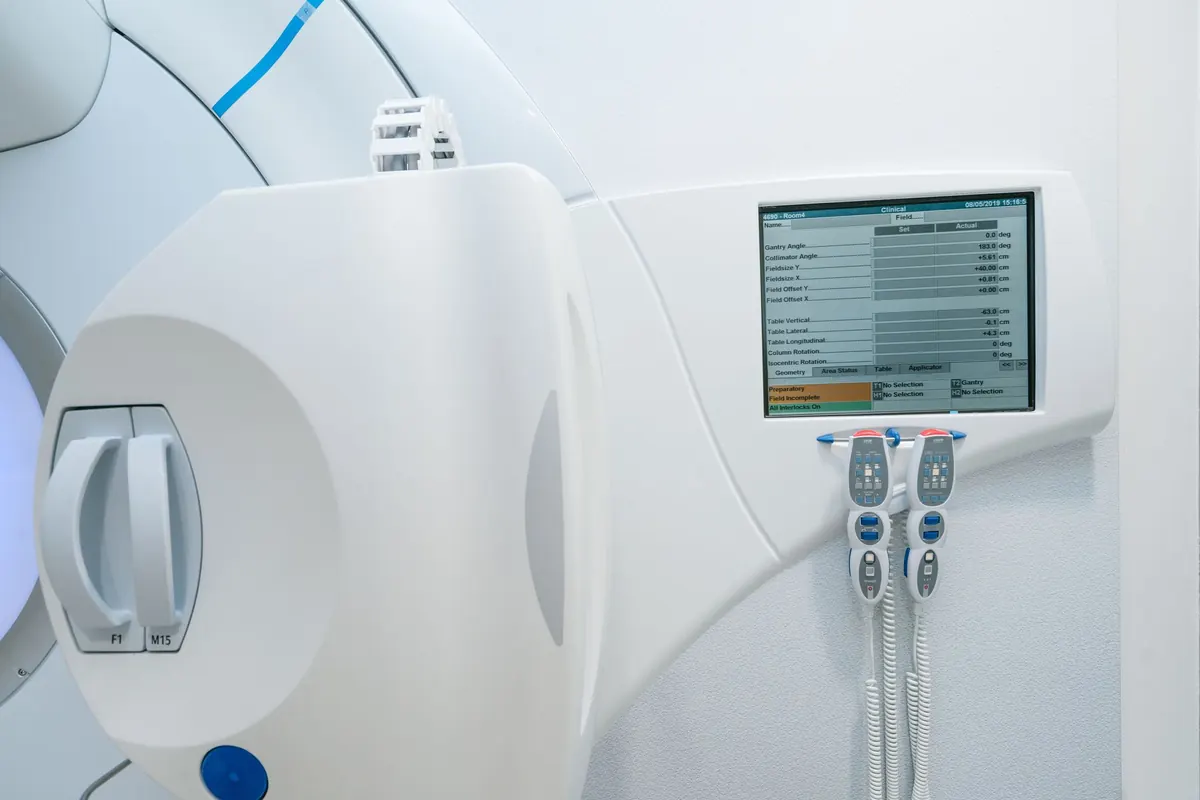
Teletherapy machines built around cobalt-60 have treated cancer for decades, and Gamma Knife systems use a large number of cobalt-60 sources arranged to converge on a small target in the brain. Modern linear accelerators produce higher-energy beams and are more flexible, but cobalt units are mechanically simple and need relatively little specialist maintenance, which keeps them in service in many parts of the world. Expect source replacement roughly every five years or so as activity decays.
Large cobalt-60 irradiators sterilise single-use medical devices — syringes, gloves, sutures, implants — and are also used to reduce microbial loads on spices and some other foodstuffs. The commercial advantage is penetration: because gamma rays pass through sealed packaging, a product can be sterilised after it is packed, so the sterile barrier is never opened again.
Industrial radiography with cobalt-60 reveals defects in welds, castings and pipework on sites where a portable X-ray set would lack the penetrating power to get through thick steel. Gamma sources also sit inside thickness gauges, level gauges and density meters in heavy process plants, quietly measuring without touching the material.
Cobalt-57 decays by electron capture and produces a gamma ray at 122 keV, with a second line close by. That is low energy by comparison with cobalt-60, so it is easy to shield — and easy to use as a reference signal rather than as a treatment beam. Its half-life of about 272 days gives it a working life measured in months rather than years.
Its most distinctive role is as the parent source for iron-57 Mössbauer spectroscopy. Cobalt-57 embedded in a rhodium matrix decays into an excited state of iron-57, which then emits the 14.4 keV gamma used to probe the oxidation state and local environment of iron. Geologists use it on minerals, corrosion engineers use it on rust layers and steel surfaces, and catalyst researchers use it to see what iron is doing during a reaction.
Beyond spectroscopy, cobalt-57 appears as a calibration source for gamma cameras and detectors in nuclear medicine, as an excitation source for X-ray fluorescence instruments, and historically as a label in vitamin B12 absorption testing. If you want a source for checking that an instrument is still reading correctly, this is usually the one.
Cobalt-58 decays by electron capture with positron emission and a gamma ray near 811 keV, and its roughly 71-day half-life makes it convenient for studies that run over weeks rather than years. It is used as a radiotracer in metallurgy and materials research: cobalt-bearing alloys can be activated in a sample, then the movement of wear debris, corrosion products or erosion particles tracked through a test rig or a lubricant circuit.
The other place cobalt-58 shows up is nuclear facilities. Nickel-58 absorbs a neutron and becomes cobalt-58, so the isotope appears in reactor coolant, in deposits on pipework, and in dose assessments during maintenance and decommissioning. Seeing cobalt-58 in a sample tells an analyst that nickel-containing alloys have been sitting in a neutron field. Cobalt-60 also forms in the same components, from neutron capture on cobalt-59, so the two are often measured together.
Production is a specialised business with a small number of suppliers, so lead times and transport rules matter. If a project depends on a specific isotope, build the delivery schedule into the plan from the start.
Start by naming the isotope. Radiation safety, shielding design, storage containers and disposal routes are all isotope-specific, and a vague reference to "a cobalt source" is not enough for anyone to advise you properly.
Then plan around decay. Activity falls continuously, so calibration schedules and source replacement dates should be worked out in advance rather than discovered when a machine underperforms. Confirm that your shielding is adequate for the gamma energies involved — cobalt-60 requires dense, substantial shielding, while cobalt-57 is far more forgiving, though sealed sources should still be treated as sealed and handled under your local procedures.
Finally, engage your radiation protection adviser before buying, moving, storing or disposing of any source. Licensing, transport documentation, leak testing and record-keeping requirements differ between countries and between sites, and they are not something to guess at. If you are commissioning equipment or planning a study involving these isotopes, take professional advice from a qualified radiation protection specialist early; it is far cheaper than fixing the arrangement afterwards.
Photo: Jo McNamara / Pexels

A practical due-diligence checklist for cobalt juniors: jurisdiction, management track record, cash runway and...
Cobalt prices move on more than battery demand. Here is how DRC supply, Chinese refining capacity, policy and...
October 08, 2026 - Market
September 30, 2026 - Uses
Copyright © 2026 Cobalt Guide. All Right Reserved.